12 Desk Organizers for a Productive New Year Under $50
A new year feels like a clean page, and your desk is the easiest place to start. You don't need a full office makeover. A few well-chosen organizers, a tape measure, and about 30 minutes can turn a cluttered corner into a cozy spot you actually want to sit at.
Below you'll find a quick reset plan, measuring tips, and 12 organizer ideas. Ten are products to shop for and two are free ideas using things you already own. Every product idea is meant to stay at or under $50.
Before you buy: measure your space
The most common desk-organizer mistake is buying something that is too big or too small. Grab a tape measure and note these numbers:
- Desk depth: Most desks are 24 to 30 inches deep. Leave at least 12 inches of clear space in front of your keyboard for writing or a notebook.
- Desk width: Measure the free space on each side of your laptop or monitor. Many desktop organizers are 8 to 14 inches wide.
- Drawer interior: Measure length, width, and height. Shallow drawers are often under 2 inches deep, so check before buying tall trays.
- Wall space: If you want something vertical, measure the open wall above your desk, too.
- Cord reach: Note how far your outlet or power strip is from your desk. This helps you choose cable storage.
Cozy tip: Pick one or two materials, such as warm wood and matte black, or white and soft gray, so everything looks like a set. A matching look makes a small desk feel calmer.
A 30-minute desk reset
Before you add any organizers, clear what you don't need. It's much easier to choose storage when you know how much you're storing.
- Empty the surface (5 minutes). Put everything in a laundry basket or box. Wipe the desk down.
- Sort into three piles (10 minutes). Keep, relocate, and toss. Dried-out pens, old receipts, and tangled chargers usually land in the toss pile.
- Group what's left (5 minutes). Sort items into writing tools, paper, tech and cords, and small extras like sticky notes and clips.
- Assign zones (5 minutes). Place daily items within about 18 to 24 inches of your dominant hand. Keep weekly items in drawers or on a shelf.
- Add organizers last (5 minutes). Set them where each group lives, then step back and adjust.
What to look for in a desk organizer
- A small footprint. An organizer that fits in 6 by 8 inches can still hold a surprising amount if it uses vertical space.
- Stable bases. Look for non-slip feet or a weighted base so it doesn't tip when you pull out a pen.
- Open access for daily items. If you use it every day, you shouldn't need to open a lid.
- Closed storage for visual clutter. Boxes and drawers hide the messy stuff.
- Easy cleaning. Wipeable surfaces such as metal, acrylic, and sealed bamboo are handy for dusty desks.
Our picks
These are the 10 product types behind this list. Each pick is a category to shop for, so compare sizes and materials against your own measurements before buying.
Pick 1: Mesh desktop organizer with pen cup
A classic for a reason. Look for a model with a pen cup, a small tray, and a slot or two for notepads. A footprint of roughly 6 by 9 inches suits most desks. Mesh looks light and modern, and it pairs well with a warm lamp or a small plant.
Pick 2: Monitor riser with storage underneath
A riser lifts your screen so the top edge sits at or slightly below eye level, which is easier on your neck. A height of about 4 to 6 inches works for many setups. The space underneath can hold your keyboard when you're done working, plus notebooks. Check that the width suits your monitor or laptop, and that the shelf can hold the weight.
Pick 3: Bamboo drawer organizer set
If your drawer is a jumble of tape, scissors, and loose pens, an adjustable set of bamboo dividers can bring order. Measure the interior first. Many sets have expandable trays, so you can fit them to your exact drawer length. Bamboo also adds a warm, natural touch that suits a cozy workspace.
Pick 4: Clear stackable drawer trays
Clear trays show what's inside at a glance, which means less digging. Use small ones for paper clips, USB drives, and earbuds, and larger ones for sticky notes and envelopes. Look for non-slip bottoms. Trays about 3 by 6 inches and 6 by 9 inches are flexible sizes that fit many drawers.
Pick 5: Vertical file holder
Standing files free up flat space and keep papers visible. Choose a width of about 3 to 4 inches per section, and consider one with two or three compartments. Label the sections, such as To Do, To File, and Reference, so paper doesn't pile up.
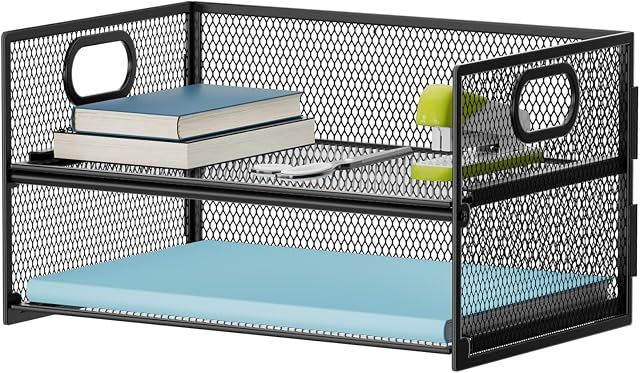
Pick 6: Stackable letter tray
A two- or three-tier tray gives incoming and outgoing paper a home. Set it up so the top tray holds anything you need to act on this week. A standard letter tray fits 8.5 by 11 inch paper, so look for an interior at least 9 by 12 inches.
Pick 7: Cable management box
Power strips and tangled adapters are what make a desk look messy. A cable box, usually 12 to 16 inches long, hides the strip and extra cord length while leaving openings for plugs. Check that your power strip fits with a little room to spare, since plugs and bulky adapters take up space. Keep it ventilated and don't cover anything that gets hot.
Pick 8: Cord clips or adhesive cable holders
These small clips keep charging cables from sliding behind the desk. Stick one at the edge of your desk, thread your cord through, and your charger stays put. Clean the surface with rubbing alcohol before sticking them on so they hold well.
Pick 9: Desktop pegboard or grid organizer
If you're short on surface space but have a bit of wall or a freestanding spot, a pegboard or wire grid lets you hang small baskets, hooks, and shelves. Aim for a panel about 12 by 16 inches or larger so you can rearrange pieces over time. It also doubles as a spot for notes and a favorite postcard.
Pick 10: Large desk pad
A desk pad defines your workspace, protects the surface, and gives your mouse a smooth place to glide. A size of about 31 by 15 inches fits a keyboard and mouse together. Soft felt or wipeable faux leather can warm up the look of any desk.
Two free ideas to round out the list
Not everything needs to be bought. These two use things you probably already have.
Idea 11: A repurposed jar or mug
A clean jar or a mug you don't use can hold pens, scissors, and rulers. Keep to one or two per desk so it doesn't turn into clutter. A matching mug and jar can look intentional.
Idea 12: A shoebox drawer divider
Cut a shoebox lid or a piece of cardboard to the width of your drawer, and fold the edges to make a tray. It's a handy temporary divider while you figure out what you really need. Try it first, then buy permanent organizers once you know the sizes.
How to combine your picks
You don't need all 12. Here are a few combinations for different desks:
- Small desk (under 40 inches wide): Pick 1, Pick 8, and Pick 10. Keep the rest in a drawer with Pick 4.
- Paper-heavy desk: Pick 5, Pick 6, and Pick 3. Add a weekly five-minute filing habit.
- Tech-heavy desk: Pick 2, Pick 7, and Pick 8. Your cords and screen get tidy at the same time.
- Wall-friendly corner: Pick 9 with Idea 11, a few hooks, and a small plant.
Keep it going all year
Organizers help, but habits are what keep the desk clear. Try these:
- Two-minute close-out. Before you log off, return items to their spots and wipe the surface.
- Weekly paper check. Every Friday, empty the letter tray and file or toss what's inside.
- Monthly drawer review. Remove anything you haven't used in 30 days.
- One in, one out. When something new comes in, something old goes out.
Final thoughts
A productive desk is simple: a clear surface, a home for each item, and a setup that fits your space. Start by measuring, pick two or three organizers, and add more only when you need them. Then add something that makes you smile, like a candle, a small plant, or a cozy lamp, and you've got a workspace ready for the new year.